How to Read Animal Tracks and Signs in Mud, Snow and Sand
The best tracking conditions rarely last. A hard frost, a fresh fall of snow, a tide that leaves wet sand smooth as paper — these are gifts, and they close fast. Mud dries, snow melts, dogs trample the lot. So when the ground is soft and the weather is on your side, get out early and look down.
Tracking is not about memorising a hundred pictures. It is about learning a handful of shapes well, then reading how they were made. A print tells you which animal passed, but the spacing and pattern tell you how it was moving and, often, what it was doing. That is where it gets interesting.
Britain has a modest list of larger mammals, which is good news for beginners. You will mostly be sorting between fox, badger, otter, deer, hare, rabbit, cat, dog, and the small stuff — mice, voles, squirrels, rats. Get those straight and you can identify most of what you find.
Start with the ground, not the print
Before you identify anything, work out whether the substrate will hold a print at all. Each surface behaves differently, and each flatters different species.
Mud
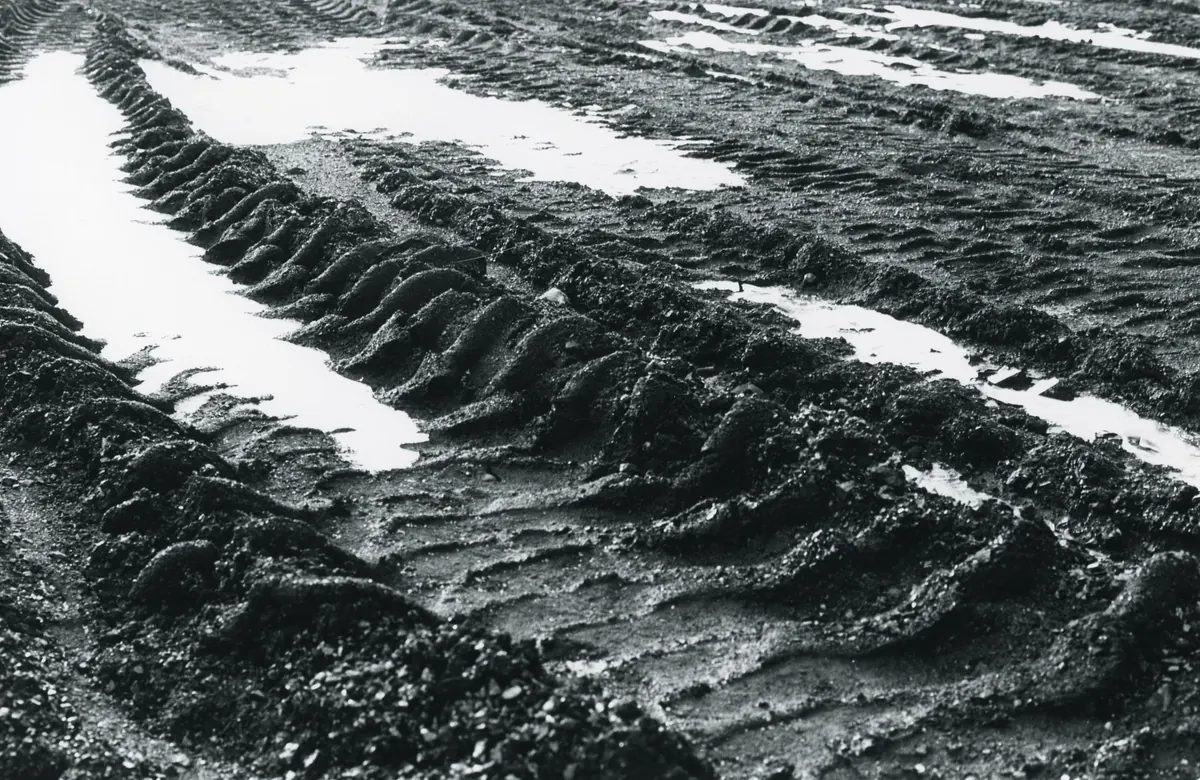
Mud is the most revealing surface and the most perishable. Wet clay and silt record pad shapes, claw marks and even hair impressions with startling fidelity. The trade-off is that mud also slumps: a print made in sloppy ground can look far bigger than the animal that made it. Depth exaggerates size. Measure across the pad, not the outer rim of displaced mud.
Mud along ditch edges, cattle-poached gateways and woodland rides is prime. Look on the shaded side of hedges where the sun has not yet baked the surface.
Snow
Snow is the great storyteller. Fresh snow, laid overnight on a still night, will show you a whole night's wanderings — where a fox paused, where a deer browsed, where a stoat dived. The catch is melt. As snow warms, prints enlarge by roughly a fifth or more, and crisp edges round off. If you are measuring anything, measure on the day the print was made, or work from the clearest, coldest patches.
Thin snow over hard ground is better than deep powder. Powder collapses and gives you a trench rather than a print.
Sand
Sand is best on the coast, above the tide line, where it is damp but not saturated. Damp sand holds detail well and resets with every tide, so anything you find is recent. Dry, wind-blown sand is nearly useless — grains collapse inwards and you lose everything. Look at dune slacks, estuary edges and the firm strip just above the waterline.
The core shapes: what you are looking for
Most mammal feet fall into a few broad types, and knowing the type narrows things down before you look at details.
- Dog family (fox, dog): four toes, non-retractable claws usually visible, a triangular heel pad with a distinct front notch. Prints tend to sit in a fairly straight line.
- Cat family (wildcat, domestic cat): four toes, claws usually retracted and therefore absent from the print, and a rounded heel pad with a three-lobed rear edge. Cats walk with a narrow, almost single-file gait.
- Badger: five toes on each foot, broad and plantigrade — you see a long, kidney-shaped pad with the whole foot pressed down. Claw marks are long and often very clear in front of the toes.
- Otter: five toes, webbed, with a wide pad and a distinctive chevron or diamond arrangement of the toe marks. Often near water, often with a drag mark from the tail.
- Deer (roe, fallow, muntjac, red): two hooves, cloven, giving a paired slot print. Roe are small and neat; fallow and red are much larger. In soft ground the dewclaws may show behind.
- Hare and rabbit: asymmetric prints — small, round front feet and long, narrow hind feet. Hares leave a wider gap between the pairs.
Reading the gait
Once you know the shape, look at the pattern of four or five consecutive prints. Gait is often more diagnostic than a single smudged print.
A walk gives a fairly regular, evenly spaced sequence with the hind foot usually landing close to or on top of the front print. A trot is a diagonal two-two pattern, common in foxes heading somewhere with purpose. A bound — seen in rabbits, squirrels and stoats — shows the two front feet landing together, then the two hind feet swinging forward past them, leaving groups of four. A gallop stretches that out further, with the body extended and the spacing uneven.
Fox and dog prints are the classic confusion. Clues worth weighing up: dogs tend to wander, cross their own path and leave prints fanned around a scent mark; foxes are usually purposeful and straight. Dog prints are generally blunter and more splayed, and the claws are thicker. It is not foolproof, but taken together with the setting — a footpath versus a field margin at dawn — it usually settles the question.
Field signs beyond the print
Tracks fade, but the evidence of an animal's presence often lingers for weeks. If you find nothing in the mud, look for these instead.
- Scat (droppings). Shape, contents and placement all matter. Fox scat is often twisted with a tapered end and frequently left on a prominent stone or tuft. Otter spraint is dark, crumbly and usually on a flat rock near water, often with fish scales and bones in it.
- Feeding remains. Nibbled hazelnuts with a neat round hole mean small rodents; a split, jagged nut shell is more likely squirrel. Snipped stems at a clean angle suggest deer or rabbit browsing.
- Paths and runs. Badgers use the same routes for generations, wearing narrow, well-worn paths through undergrowth. Rabbit runs are smaller and often thread through grass.
- Scratch marks and scent marking. Deer fray small saplings with their antlers; badgers leave shallow scratch pits at latrine sites.
- Hair and feathers. Snagged fur on a barbed wire fence or a low branch tells you what passes through and how often.
Practical tips for a better day out
Go early, before dog walkers and sunlight spoil the surface. Walk beside tracks rather than on them, and step back before you lean in to look — a boot print in the middle of a good trail is a small tragedy.
Carry a torch with a low, angled light for raking across prints at dusk, and a notebook and pencil rather than a phone, which will fog up in the cold. Sketch the whole sequence rather than one print; note the spacing, the direction and the substrate. A ruler or a coin laid beside a print in a photograph makes later comparisons far easier.
Be honest about uncertainty. A blurred slot print in wet clay might be roe deer or it might be muntjac, and saying so is better than a confident guess. Tracking rewards patience and repeated visits to the same patch of woodland far more than a single lucky find. Pick one local wood or stretch of riverbank, visit it through the seasons, and learn its regulars properly. That is how the shapes become second nature.
Photo: Malcolm Hill / Pexels